
Congratulations to Owais Khan, whose paper "Non-Newtonian vs. numerical rheology: Practical impact of shear-thinning on the prediction of stable and unstable flows in intracranial aneurysms" was just accepted by Int J Numer Methods Biomed Eng. Abstract below:
Computational fluid dynamics (CFD) shows promise for informing treatment planning and rupture risk assessment for intracranial aneurysms. Much attention has been paid to the impact on predicted hemodynamics of various modelling assumptions and uncertainties, including the need for modelling the non-Newtonian, shear-thinning rheology of blood, with equivocal results. Our study clarifies this issue by contextualizing the impact of rheology model against the recently-demonstrated impact of CFD solution strategy on the prediction of aneurysm flow instabilities. Three aneurysm cases were considered, spanning a range of stable to unstable flows. Simulations were performed using a high-resolution/accuracy (HR) solution strategy with Newtonian and modified-Cross rheology models, and compared against results from a so-called ‘normal resolution’ (NR) strategy. Time-averaged and instantaneous wall shear stress (WSS) distributions, as well as frequency content of flow instabilities and dome-averaged WSS metrics, were minimally affected by the rheology model, whereas numerical solution strategy had a demonstrably more marked impact when the rheology model was fixed. We show that point-wise normalization of non- Newtonian by Newtonian WSS values tended to artificially amplify small differences in WSS of questionable physiological relevance in already-low WSS regions, which might help to explain the disparity of opinions in the aneurysm CFD literature regarding the impact of non-Newtonian rheology. Towards the goal of more patient-specific aneurysm CFD, we conclude that attention seems better spent on solution strategy and other likely ‘first-order’ effects (e.g., lumen segmentation, choice of flow rates), as opposed to ‘second-order’ effects such as rheology.
Wednesday, September 28, 2016


Wednesday, September 16, 2015
Max Julian thesis defense
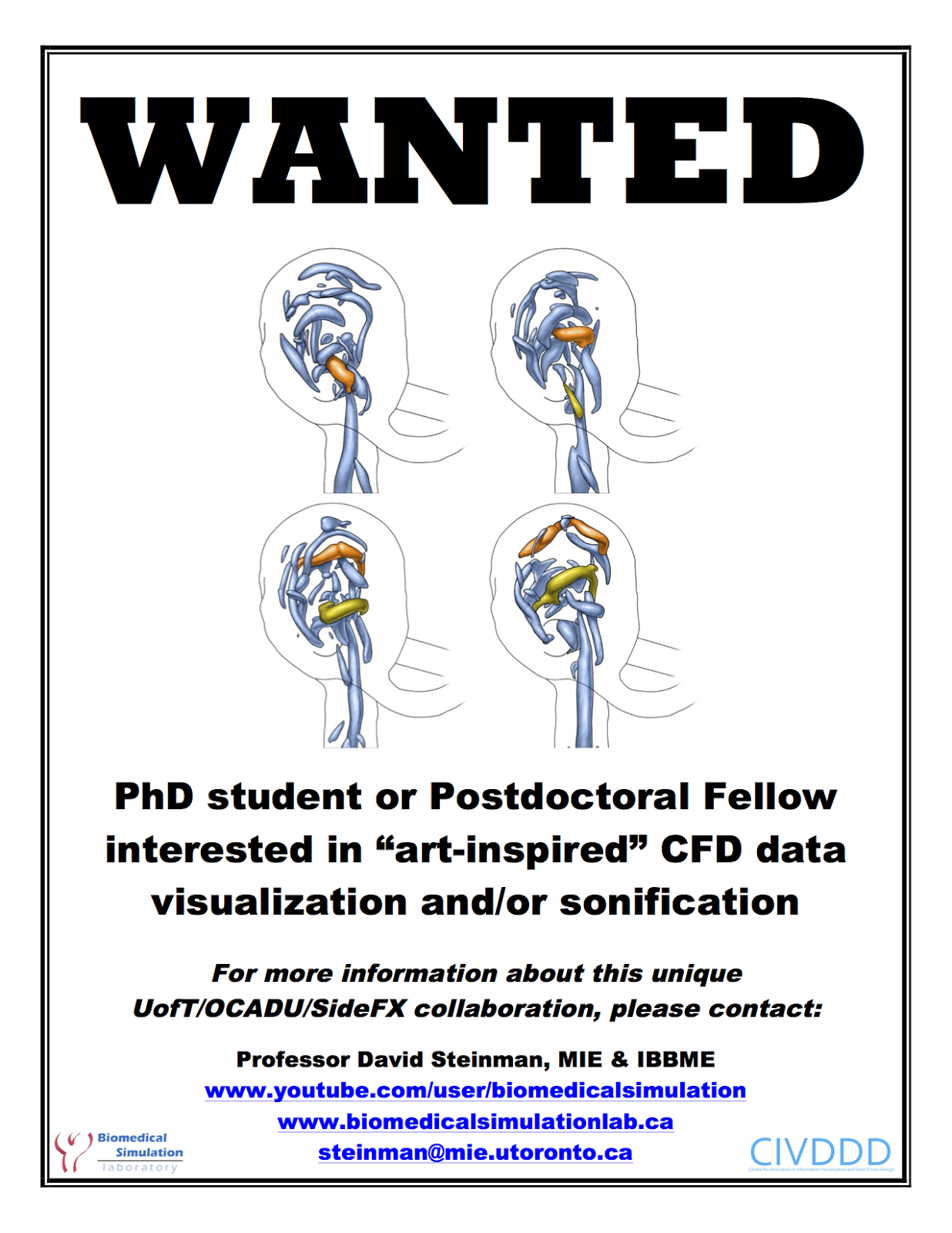
Congratulations to BSL Master's student Max Julian (aka Massimo Iuliano :-), on the (very) successful defense of his thesis, "Illustration-Inspired Visualization of Blood Flow Dynamics". Thanks to Nick Woolridge and Mark Chignell, Max's thesis examiners, and a special shout out to my colleague and Max's co-supervisor, Peter Coppin from OCADU, whose creativity, drive, enthusiasm, and optimism in the face of adversity have made this art/science collaboration possible and successful.
KVS wins award at ECI conference

Yours truly was a co-chair of the conference, but was not involved in the judging, and didn't even know who the judges were!
Wednesday, July 29, 2015
An entertaining take on peer review
Please take a moment to read (if time and your library access allows) this letter to the editor from Bob Mulkern, on the subject of peer-review. Wish I could post full text, but then there are those pesky copyright issues :-)
Monday, June 22, 2015
Student awards, SB3C 2015

Congratulations to BSL PhD student Muhammad Owais Khan, whose presentation "CFD simulation of transition to turbulence for Newtonian vs. non-Newtonian flow through a stenosis" won first prize at the Biotransport and Simulation PhD student competition of the 2015 Summer Biomechanics, Bioengineering, and Biotransport Conference in Snowbird, Utah. Here Owais is shown with proud co-authors Frank Loth, yours truly (with exit sign), Kristian Valen-Sendstad aka KVS, and some random guy in the background.
Congratulations also to BSL PhD student Resmi KrishnankuttyRema, whose presentation "Inlet flow rate variation and onset of flow instabilities in the carotid siphon" was a finalist for the Biofluids PhD student competition. Like Owais, Resmi knocked it out of the park with her talk, but faced some stiff competition. Well done both!
Tuesday, March 31, 2015
Best Research Article nominee in AJNR
Congratulations to BSL "postdoc emeritus" Kristian Valen-Sendstad, whose 2013 paper in the American Journal of Neuroradiology (AJNR) was apparently a nominee for AJNR's inaugural Lucien Levy Best Research Article Award.
Sunday, December 28, 2014
Making the case for basic science research
I can't say I was ever a huge fan of Neil deGrasse Tyson, but now I am. His clever (and accurate) tweets about winter solstice rituals aside, watch this interview, where he patiently, er, 'unpacks' Fareed Zakaria and the CNN viewership regarding the importance of basic science research. And all without screed; just deft sardonicism.
Wednesday, December 3, 2014
Minding the Gap
Apologies for the long absence, but professional and personal commitments keep me distracted from (other) writing. Nevertheless, I wanted to share some very good news about some recent work published in AJNR.
 First, people are sitting up and taking notice of our "Mind the Gap" paper. It has been featured in the December 2014 AJNR Digest, and also a special collection of articles called "Aneurysms and the American Journal of Neuroradiology: The Next 20 Years", which as its eye candy features a figure from our paper (see right).
 Congratulations to Kristian Valen-Sendstad, whose tireless (and often, er, turbulent) efforts to promote good practice in aneurysm CFD appear to be paying off.
Second, congratulations to PhD student Owais Khan, whose first journal article, a follow-up to "Mind the Gap", was recently accepted by AJNR. Here's a preview:
Narrowing the Expertise Gap for Predicting Intracranial Aneurysm Hemodynamics: Impact of Solver Numerics vs. Mesh and Time-step Resolution
M. Owais Khan, Kristian Valen-Sendstad, David A. Steinman
Methods: We focused on three MCA aneurysms, exemplifying highly unstable, mildly unstable, or stable flow phenotypes, respectively. For each, the number of mesh elements was varied by 320x, and the number of time steps by 25x. CFD simulations were carried out using an optimized second-order, minimally dissipative solver, and a more typical first-order, stabilized solver.
Results: With the optimized solver and settings, qualitative differences in flow and wall shear stress patterns were negligible for models down to ~800,000 tetrahedra and ~5000 time steps per cardiac cycle, and could be solved within clinically acceptable timeframes. At the same model resolutions, however, the stabilized solver had poorer accuracy, and completely suppressed flow instabilities for the two unstable flow cases. These findings were verified using the popular commercial CFD solver, Fluent.
Conclusions: Solver numerics must be considered at least as important as mesh and time-step resolution in determining the quality of aneurysm CFD simulations. Proper CFD verification studies, and not just superficial grid refinements, are therefore required in order to avoid overlooking potentially clinically- and biologically-relevant flow features.
Friday, February 28, 2014
Peer review fail
This would be funny if it weren't true: http://www.theguardian.com/technology/shortcuts/2014/feb/26/how-computer-generated-fake-papers-flooding-academia
Friday, February 21, 2014
(Re)Mind the Gap
We were pleasantly surprised to find out that BSL postdoc Kristian Valen-Sendstad's paper in press with AJNR, "Mind the gap: Impact of CFD solution strategy on prediction of intracranial aneurysm hemodynamics and rupture status indicators", is the subject of a commentary -- all the more surprising because AJNR wasn't too keen on the paper when it was first submitted :-) Way to go Kristian!
Monday, January 27, 2014
Evangelical Scientists Refute Gravity With New 'Intelligent Falling' Theory
Courtesy of the Onion: http://www.theonion.com/articles/evangelical-scientists-refute-gravity-with-new-int,1778/. It would be funny if it didn't ring so true. *sigh*
Monday, December 30, 2013
We need to talk about TED
Couldn't have said it better myself: http://www.theguardian.com/commentisfree/2013/dec/30/we-need-to-talk-about-ted. Thanks to Roberta Buiani for posting this on her Facebook page.
Monday, December 23, 2013
Paper Published: Carotid Bifurcation Geometry Is an Independent Predictor of Early Wall Thickening at the Carotid Bulb

As it turns out, the answer is "yes, but". "Yes", because we did tease out a significant and independent association between early wall thickening and bifurcation flare & curvature geometric parameters; "but", because the association was relatively weak.
An equally interesting aspect of the study was the care we had to take to exclude secondary effects of thickening on geometry. Had we not done so -- and as we showed -- the associations would have been even weaker or, worse, significantly stronger but inverse to what they should have been.
Wednesday, October 16, 2013

Thursday, October 10, 2013
Whither Peer Review?
Er, thanks(?) to former BSL postdoc Yiemeng Hoi for sending me this depressing story about the ugly side of open-access publishing: http://scicomm.scimagdev.org/.
Not that traditional journals are exempt. There are simply too many journals, and good peer-reviewers are overworked, meaning that a lot of stuff gets relegated to potentially unqualified reviewers. And the pressure to publish N papers per year has led to a "let's throw it at the wall and see if it sticks" attitude to journal article submission. Science suffers from all of this noise, and we have only ourselves to blame for falling into the bibliometric trap set for us by the bean-counters.
Which makes me wonder. Should I review articles from groups I know and trust to be careful and honest, and nit pick their papers to make sure they are rock solid and bullet-proof? Or should I spend time instead reviewing for lesser journals and novice authors, where the reviewer is implicitly being asked to teach the authors how to write a paper, to make sure that crap doesn't inadvertently make it into the system?
Paper accepted, Am J Neuroradiol

I never know what is the embargo policy for specific journals, but since the printer has delayed the processing of our paper (accepted almost three months ago), I think it's fair that we share the good/bad news about a study led by BSL postdoc Kristian Valen-Sendstad, entitled: "Mind the gap: Impact of CFD solution strategy on prediction of intracranial aneurysm hemodynamics and rupture status indicators". Here's the abstract, paper (hopefully) coming soon:
Materials and Methods: Pulsatile flow in 12 realistic MCA aneurysms was simulated using both high resolution (HR) and normal resolution (NR) strategies. Velocity fields were compared at selected instants via domain-averaged error. Wall shear stress (WSS) fields and various reduced hemodynamic indices were also compared: cycle-averaged mean and maximum WSS; oscillatory shear index (OSI); low shear area (LSA); viscous dissipation ratio (VDR); kinetic energy ratio (KER).
Results: Instantaneous differences in flow and WSS patterns were appreciable, especially for bifurcation aneurysms. Linear regressions revealed strong correlations (R2>0.9) between HR and NR solutions for all indices but KER (R2=0.25) and OSI (R2=0.23); however, for most indices the slopes were significantly less than one, reflecting a pronounced underestimation by the NR simulations. Some HR simulations were highly unstable with fluctuating WSS, reflected by the poor OSI correlation.
Conclusion: Typical CFD solution strategies may ultimately be adequate for augmenting rupture risk assessment based on certain highly-reduced indices; however, they cannot be relied upon for predicting the magnitude and character of the complex biomechanical stimuli to which the aneurysm wall may be exposed. This impact of CFD solution strategy is likely greater than that for other modelling assumptions or uncertainties.
Saturday, September 21, 2013
NYT rakes our prime minister, er, over the coals
Your correspondent is back after a long absence. Apologies for the copyright violation, but this New York Times editorial is too "good" not to share, although I'm sure it will be dismissed as commie pinko propaganda. Dark Age Ahead, my friends. Or, to put it more colloquially, "money talks, bullshit walks".
Silencing Scientists
By Verlyn Klinkenborg
Published: September 21, 2013
Over the last few years, the government of Canada — led by Stephen Harper — has made it harder and harder for publicly financed scientists to communicate with the public and with other scientists.
It began badly enough in 2008 when scientists working for Environment Canada, the federal agency, were told to refer all queries to departmental communications officers. Now the government is doing all it can to monitor and restrict the flow of scientific information, especially concerning research into climate change, fisheries and anything to do with the Alberta tar sands — source of the diluted bitumen that would flow through the controversial Keystone XL pipeline. Journalists find themselves unable to reach government scientists; the scientists themselves have organized public protests.
There was trouble of this kind here in the George W. Bush years, when scientists were asked to toe the party line on climate policy and endangered species. But nothing came close to what is being done in Canada.
Science is the gathering of hypotheses and the endless testing of them. It involves checking and double-checking, self-criticism and a willingness to overturn even fundamental assumptions if they prove to be wrong. But none of this can happen without open communication among scientists. This is more than an attack on academic freedom. It is an attempt to guarantee public ignorance.
It is also designed to make sure that nothing gets in the way of the northern resource rush — the feverish effort to mine the earth and the ocean with little regard for environmental consequences. The Harper policy seems designed to make sure that the tar sands project proceeds quietly, with no surprises, no bad news, no alarms from government scientists. To all the other kinds of pollution the tar sands will yield, we must now add another: the degradation of vital streams of research and information.
Tuesday, March 26, 2013
So long, Flanders!

Tuesday, February 19, 2013
SBC2012 CFD Challenge published in J Biomech Eng

Subscribe to:
Posts (Atom)
